Standards are the difference between policy ambition and real-world performance
When governments and industries talk about biodiesel, the conversation often focuses on blend levels—B5, B7, B20. But global experience shows that blends alone don’t determine success. Standards do.
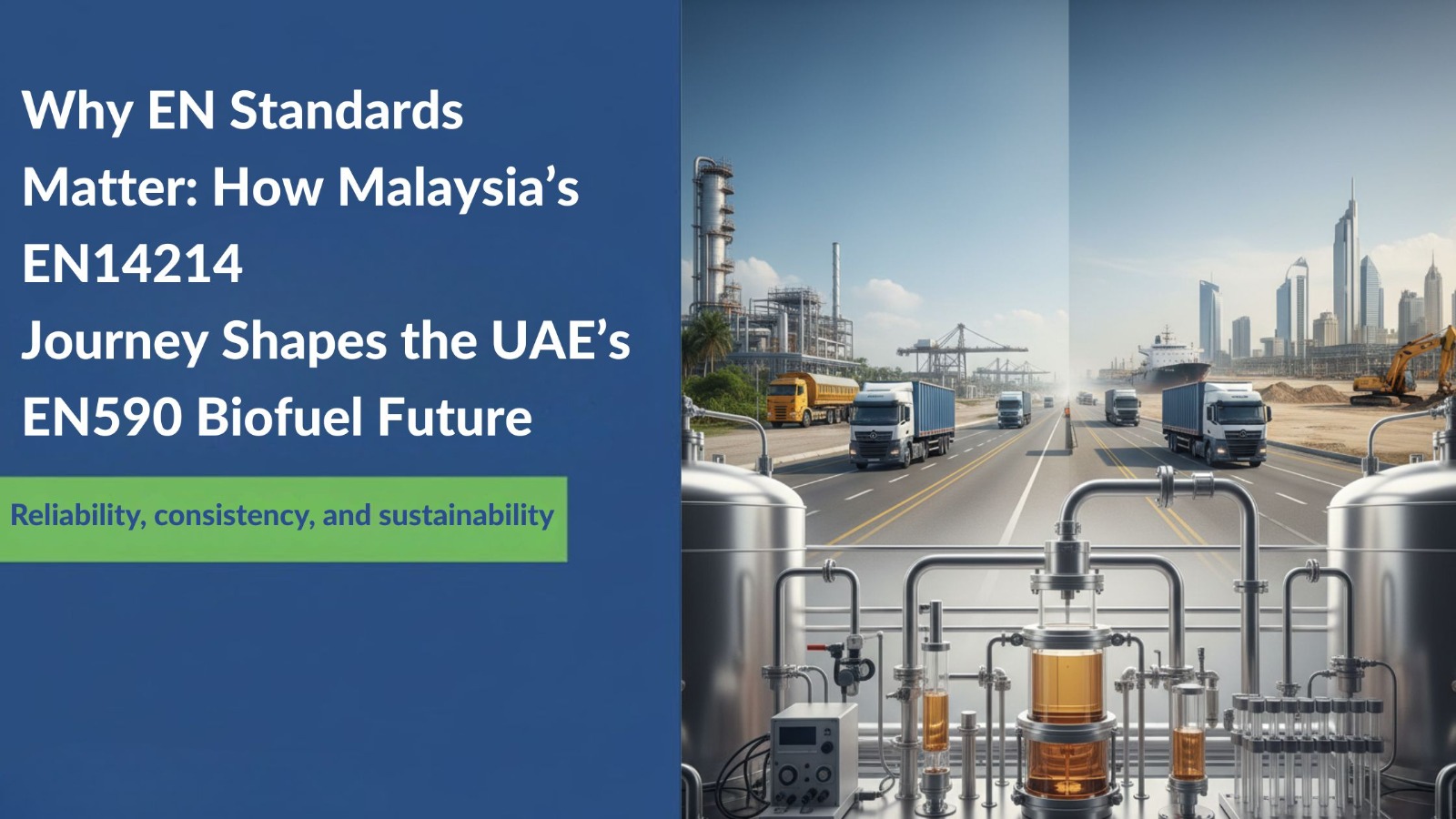
Malaysia’s biodiesel journey, built over nearly two decades, demonstrates a critical lesson for the UAE: fuel quality frameworks like EN14214 and EN590 are what turn sustainability targets into operational reality.
For fleet owners, industrial operators, and procurement teams, these standards aren’t paperwork—they’re protection for engines, uptime, and long-term fuel confidence.
What EN standards actually do
EN standards exist to ensure that fuels behave predictably in real-world conditions. In simple terms:
● EN590 defines what high-quality automotive and industrial diesel must look like—covering cleanliness, stability, density, lubricity, and emissions-related parameters.
● EN14214 defines biodiesel quality—ensuring it can be safely blended with diesel without causing storage issues, injector fouling, or inconsistent combustion.
Together, they create compatibility. Biodiesel that meets EN14214 can be blended into EN590 diesel to produce a finished fuel that works in existing infrastructure.
Malaysia’s EN14214 journey: why quality came first
Malaysia’s biodiesel programme is often discussed in terms of palm-based feedstock or national blending mandates. But behind the scenes, its real progress came from aligning production and blending with internationally recognised standards, particularly EN14214.
Why this mattered:
● It created export credibility, allowing Malaysian biodiesel to meet European and
global expectations.
● It reduced operational risk for users by ensuring consistency.
● It supported gradual, phased adoption rather than forced market shifts.
The key lesson: without a clear biodiesel quality benchmark, higher blends increase risk instead of value.
The UAE context: EN590 is non-negotiable
In the UAE, EN590 is already deeply embedded across supply chains—from logistics fleets and generators to marine and construction equipment. Any biodiesel strategy that ignores this reality is unlikely to scale.
That’s why the UAE’s biofuel future is fundamentally EN590-led, not blend-led. Rather than replacing diesel, the smarter pathway is enhancing EN590-compatible fuels with certified biodiesel and premium bio-energy compounds—ensuring:
● no disruption to engines or fuel systems
● stable storage under regional climate conditions
● confidence for industrial operators who prioritise uptime
This approach aligns closely with UAE Net Zero ambitions while respecting how energy is actually used on the ground.
Why EN14214 matters even at low blends
Some assume biodiesel quality is only critical at higher blends like B20. Malaysia’s experience proves otherwise. Even at B5 or B7, biodiesel quality affects:
● oxidation stability
● water separation
● injector cleanliness
● long-term storage behaviour
If the biodiesel component doesn’t meet EN14214, these risks appear regardless of blend
percentage. That’s why Biofuel Plus positions its premium biodiesel fuels around EN14214-compliant biodiesel blended into EN590 diesel, then further enhanced using a proprietary bio-energy compound to deliver consistent, premium-grade performance.
From standards to finished fuel: where Biofuel Plus fits
At Biofuel Plus, standards are treated as the starting point, not the finish line. Across its portfolio:
● BFP Premium B5, B7, and B20 are finished fuels—not on-site blends—built using EN590 diesel and EN14214-compliant biodiesel, then optimised with a bio-enhancer for stability and performance.
● BFP Premium Bio EN590 offers a ready-to-use diesel solution aligned with the same quality discipline.
● Biofuel Plus B100 functions as a high-purity bio-energy compound, used in controlled quantities to support combustion efficiency, lubricity, and injector cleanliness—without engine modification.
This mirrors the strongest lesson from Malaysia: standards enable scale, but premium
quality enables confidence.
EN standards and Net Zero readiness: the quiet enabler
Net Zero strategies often focus on future technologies. But Malaysia’s experience highlights something less visible—and more immediate: Fuel quality standards are one of the fastest enablers of measurable emissions progress today.
For the UAE, EN590-aligned biodiesel solutions allow:
● immediate integration into existing fleets
● emissions reduction without asset replacement
● smoother compliance with national sustainability frameworks
In other words, EN standards turn Net Zero from a roadmap into a working system.
What decision-makers should take away
If you’re responsible for fuel procurement, sustainability, or operations, Malaysia’s EN14214 journey offers a clear checklist:
● Don’t ask only what blend—ask what standard.
● Demand EN590 and EN14214 alignment.
● Choose finished fuels over ad-hoc blending.
● Prioritise suppliers who understand regional operating conditions.
● Treat biodiesel as a quality-managed fuel system, not a commodity.
That’s how biodiesel becomes a reliable part of the energy mix—not a risk.
Final thoughts
If your organisation is preparing for Net Zero while protecting operational reliability, explore Biofuel Plus EN590-compatible premium biodiesel fuels designed around international standards, regional conditions, and real-world industrial performance.