As someone working closely with fleet operators across the UAE and international markets, I see the same
pattern repeating itself.
Industrial fleets are not asking whether diesel will remain relevant. They already know it will.
What they are asking instead is a more practical question:
How do we make diesel work better in today’s operational and sustainability environment—without
disrupting our fleets?
This is where premium bio-enhanced fuels are increasingly becoming the preferred choice.
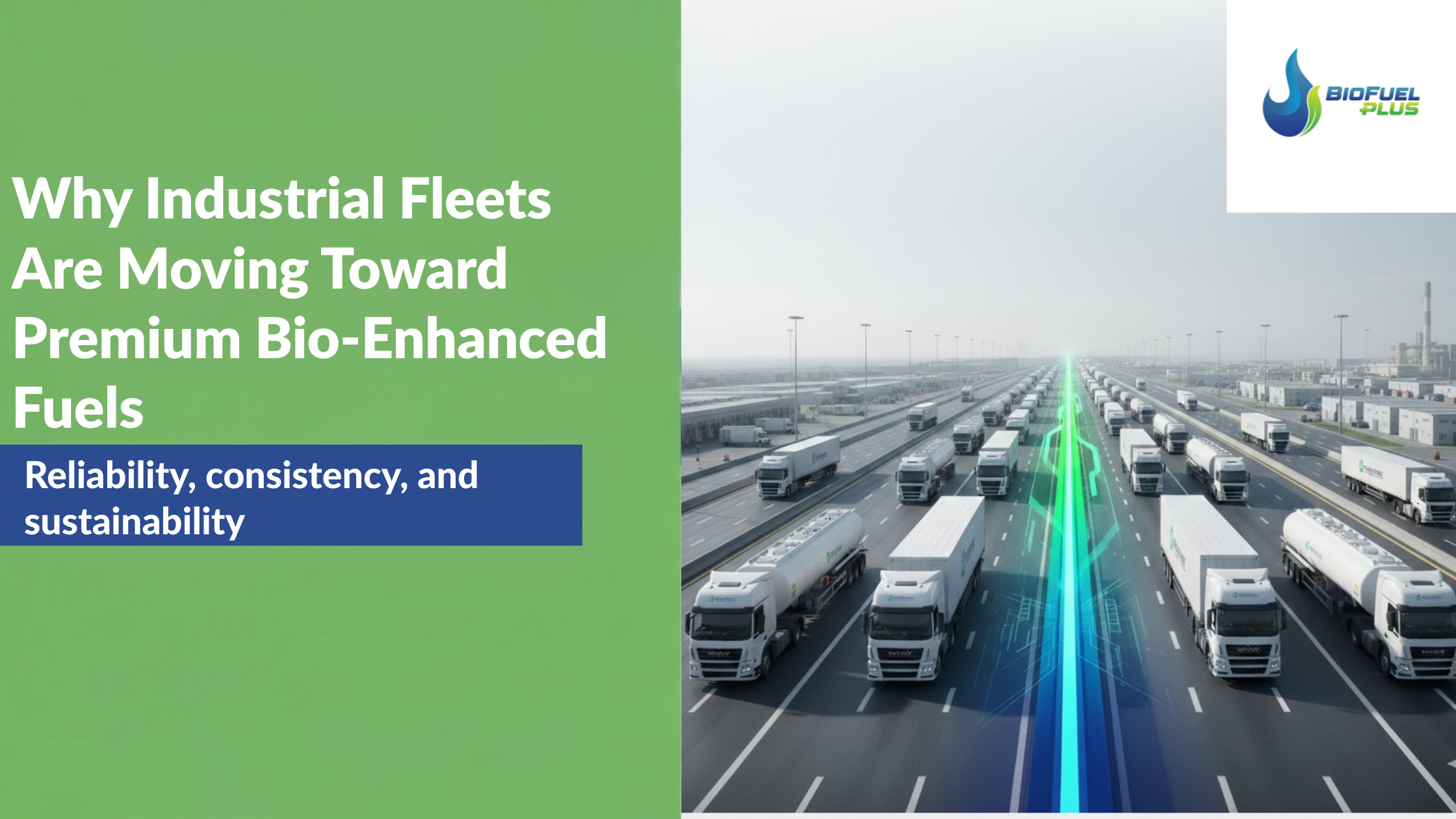
Fleet Operations Demand Stability Above All Else
Industrial fleets operate under conditions that leave little room for experimentation. Vehicles and equipment run for long hours, under variable loads, across mixed duty cycles and often in harsh environments.
From my experience, fleet managers prioritise:
● Predictable engine behaviour
● Consistent fuel performance across vehicles
● Minimal operational change
● Strong governance and documentation
Any fuel solution that introduces uncertainty, complexity, or operational risk simply doesn’t scale. This is why premium bio-enhanced fuels have gained traction—they work within existing diesel systems rather than trying to replace them.
Why “Premium” Matters in Real Fleet Environments
Fuel is often treated as a commodity, but for large fleets, it is a strategic operational input.
Premium fuels are not about novelty. They are about refinement.
At Biofuel Plus, we approach fuel from a performance and consistency perspective. Premium bio-enhanced
fuels are formulated to support:
● Stable combustion behaviour across variable operating conditions
● Cleaner operational characteristics over long run cycles
● Improved fuel utilisation efficiency without changing engines or hardware
This matters most in fleets where vehicles rarely operate under ideal or constant conditions—which, in
reality, is almost every industrial fleet.
The Role of Bio-Enhancement in Fleet Fuel Strategy
One of the most common misconceptions I encounter is that biofuel requires fleets to compromise on
reliability or performance. In practice, the opposite is often true when bio-enhancement is applied correctly. Our approach is built around BFP B100, a proprietary bio-energy enhancer that is integrated into premium fuels during formulation. It is not used on its own, and it does not require fleet-side dosing or adjustments.
When embedded into fuels such as Premium Bio EN590 and Premium B5, B7, and B20, bio-enhancement
helps support:
● More consistent combustion behaviour
● Smoother engine operation over extended cycles
● Predictable performance across mixed fleets
For fleet operators, this means progress without disruption—a critical requirement at scale.
Why Fleets Prefer Finished, Ready-to-Use Fuels
From a fleet management standpoint, simplicity is non-negotiable.
Premium bio-enhanced fuels are supplied as finished fuels, ready for direct use. There is no blending, no
recalibration, and no change in refuelling practices. Vehicles are filled and operated exactly as they always
have been.
This is one of the key reasons fleets are moving toward premium solutions rather than experimental
alternatives. They can adopt enhanced fuel performance while preserving existing infrastructure, training,
and safety procedures.
Global Adoption Is Shaping Local Decisions
What we are seeing in the UAE mirrors what has already happened in Europe and other mature industrial
markets.
Premium diesel and premium biodiesel fuels are widely used and, in many regions, mandatory. Biofuel is no longer positioned as a future concept it is an established part of industrial energy strategy.
Fleet operators in the UAE increasingly recognise this global reality. The shift toward premium bio-enhanced fuels reflects a desire to align with international best practices while maintaining local operational reliability.
A Practical Path Toward Sustainability
Sustainability in fleet operations must be practical, measurable, and scalable.
Premium bio-enhanced fuels support this by offering:
● Incremental improvement rather than abrupt change
● Compatibility with existing diesel engines
● Alignment with UAE sustainability direction and long-term energy goals
From my perspective, this is why premium fuels resonate so strongly with industrial fleets. They allow
organisations to move forward responsibly without sacrificing uptime, performance, or control.
Final Thoughts
Industrial fleets are not chasing trends. They are making calculated decisions based on reliability,
governance, and long-term operational confidence.
Premium bio-enhanced fuels represent a mature evolution of diesel use one that respects the realities of fleet operations while supporting cleaner, more efficient fuel behaviour.
At Biofuel Plus, we see this transition not as a disruption, but as a refinement. Diesel remains central.
Premium bio-enhancement simply allows fleets to get more from it consistently, responsibly, and at scale.